MHA: UNITED SURVIVAL
- 4.6
- Rating
- 1.00M
- Installs
- Free
- Price

 Analysis by App-foxy
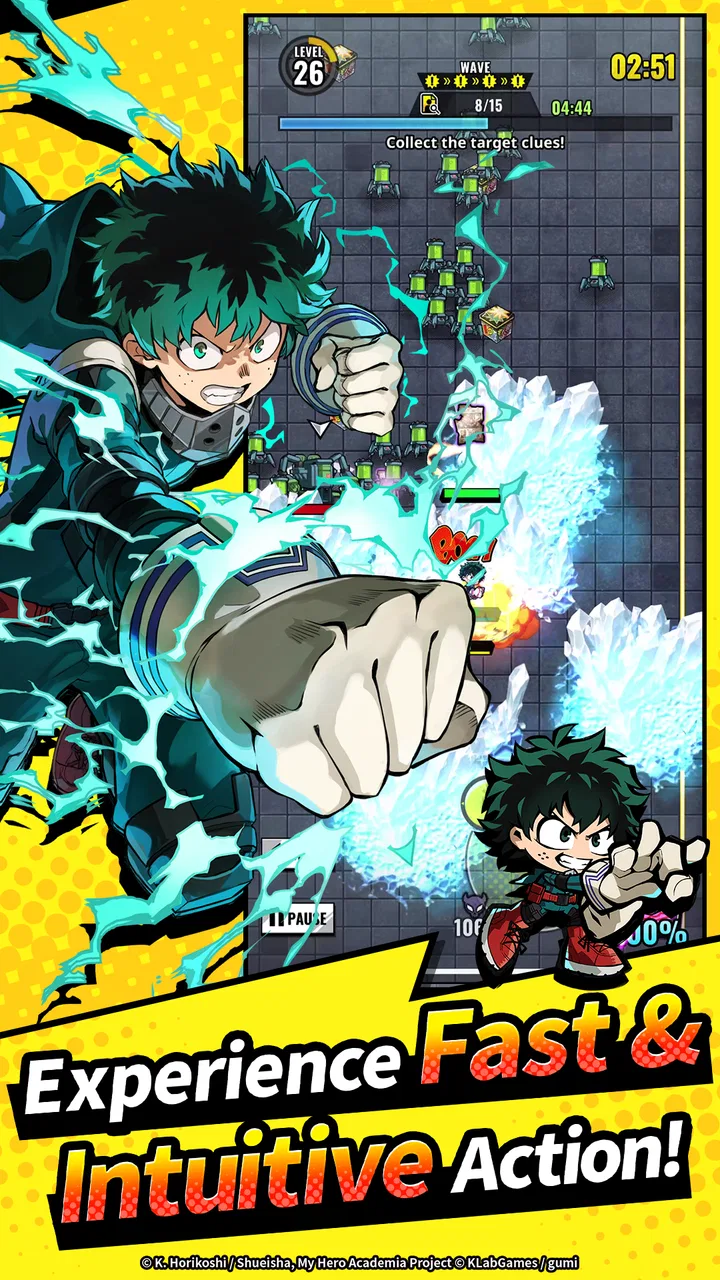
I approached MHA: UNITED SURVIVAL as an action game first, but its real test is how comfortably different people can read, control, and follow the action. KLab’s official My Hero Academia title puts the focus on powering up Quirks and fighting groups of enemies, so the experience is naturally busy and fast. I found that the game’s appeal depends less on whether you already know every character and more on whether you enjoy learning a combat rhythm while dealing with visual and motor pressure.
It is free to start, aimed at Teen players, and available for devices running Android 9 or later. The current version is 1.0.5. KLab has built it for fans who want an active superhero game rather than a passive story companion, and I think that distinction matters when deciding whether it belongs on your phone. The game can be exciting in short sessions, but it asks more from your attention and hands than a turn-based alternative would.
How clearly the game presents its action and menus
My first impression was that the game communicates through several layers at once: character movement, enemy activity, attack effects, health information, progression prompts, and the broader visual language of My Hero Academia. That can make battles feel energetic, but it also creates a readability challenge. When several enemies fill the screen, the important detail is not always the most visually prominent detail. A bright attack effect can compete with the character or target I actually need to watch.
You May Also Like

 Blood Strike: 2.5 Anniversary
Blood Strike’s Loadouts Turn Every Drop Into a Tactical Gamble
A close look at Blood Strike’s custom loadouts: how fast access to signature weapons reshapes its battle royale rhythm, rewards preparation, and narrows the gap between fights.

 Pandora - Music & Podcasts
Pandora’s Music Is Easy to Start, but Harder to Recover
Pandora’s strength is its low-effort path from a seed to a station. Its weak spot is how much confidence it asks you to place in connection, setup, and quiet recovery.

 8 Ball Pool
 Is Built on Rivalries, Rematches, and Routine
A close look at the rivalries, rematches, shared routines, and unanswered safety questions that turn a quick pool match into a persistent mobile community.

 Samsung Music
’s Quiet Strength Is Playing What You Already Own
Its reach comes less from spectacle than from dependable access to a personal library. That simplicity is both the app’s strongest retention engine and its ceiling.

 AccuWeather: Weather Radar
AccuWeather Review: A Quick, Clear Forecast for Everyday Decisions
For everyday plans, the best forecast is the one you can understand quickly. AccuWeather makes rain timing, radar, and local conditions easy to act on, with a few trade-offs.

 Hill Climb Racing
Why Hill Climb Racing Still Turns Crashes Into One More Run
A tiny car, a bumpy hill and one more upgrade: Hill Climb Racing keeps resurfacing because its simple chaos makes every near-miss feel personal.
More From Our News Desk
View All News


I found it easier to understand the game after treating each screen as a separate task. In combat, I watched the immediate threat and my character’s position. In progression areas, I slowed down and handled upgrades one decision at a time. That simple habit reduced the feeling of being rushed. New players who try to inspect every icon while a fight is unfolding may feel lost, even if the underlying systems become clearer after repeated play.
The My Hero Academia presentation helps recognition when you already know the cast. Familiar Quirks give actions a clear identity, and that makes it easier to remember what kind of attack I am using. For someone unfamiliar with the series, however, the visual spectacle may not explain every practical distinction immediately. I would recommend taking the early encounters as a learning period instead of trying to play perfectly from the start.
Navigation is most comfortable when I make a deliberate pause between battles. I use those moments to check the character I am improving, consider what the next encounter demands, and avoid tapping through menus simply because the game is offering another prompt. This is one of the more useful adjustments for players who process information slowly or who become tired when several choices arrive together.
Readable play depends on controlling the pace between fights, not only on what happens during them. That is an important distinction. The combat itself is designed to feel active, while preparation and progression reward a calmer approach. If you need a consistently quiet interface with very little visual movement, this will probably feel demanding even when the controls make sense.
Why the action can be clear one moment and crowded the next
The game’s central fantasy is built around powerful abilities, so visual impact is part of the attraction rather than an accidental extra. I enjoyed seeing attacks feel distinct and forceful, but that same intensity can make target awareness harder during crowded encounters. Players who rely on careful visual separation may want to focus on one enemy at a time instead of scanning the whole screen continuously.
A practical approach is to keep the character’s position in mind before launching an attack. I found that reacting only to the newest effect often led to unnecessary confusion. Watching where I was standing first gave me a better reference point when the screen became busy. This is a small skill, but it makes the game feel less chaotic and is especially useful for anyone who finds rapid visual changes tiring.
The game also suits players who are comfortable learning by repetition. I did not expect every mechanic to become obvious immediately, and I would not judge the experience from the first few encounters alone. Repeating a familiar type of fight can reveal which visual cues matter and which are merely decorative. That learning curve is acceptable for an action fan, though it is less welcoming than the gentler introduction offered by many slower role-playing games.
Motor demands, sensory load, and the value of short sessions
As an action title, MHA: UNITED SURVIVAL asks for timely input. The main challenge is not simply pressing buttons; it is combining movement, awareness, and attack decisions while enemies are active. I found that longer sessions made small mistakes more likely, especially when I stopped paying attention to positioning. Shorter sessions gave me better control and made the action feel more enjoyable rather than exhausting.
This makes the game a reasonable fit for someone who likes brief bursts of mobile combat. A quick session during a break can work well when I already know what I want to accomplish. I might improve a character, replay a familiar encounter, or simply enjoy a few fights. By contrast, anyone looking for a relaxed game that can be played with one hand while distracted should be cautious. The action deserves attention, and divided attention can turn a manageable encounter into frustrating input errors.
Players with limited dexterity may want to test the basic combat feel before investing time or money. Fast action can expose the difference between understanding an attack and being able to trigger it comfortably. I would not assume that liking the anime automatically means the controls will suit every player. The game’s strongest moments come when my hands can keep up with my decisions; when they cannot, the spectacle becomes pressure.
There is also a sensory consideration. The superhero style relies on motion, impact, and strong visual feedback. That is satisfying for players who want a lively screen, but it may be uncomfortable for people who are sensitive to flashing effects, dense animation, or constant movement. Since I cannot recommend the game as a low-stimulation experience, I would suggest trying it in a calm setting first rather than committing to long play sessions.
Sound can influence how intense the game feels, even when I am mainly watching the screen. For a quieter experience, I would personally lower the device volume or play without sound when surroundings allow it. That does not change the combat demands, but it can reduce the total sensory load. The game remains visually active, so this is a comfort adjustment rather than a complete solution.
How I would approach combat with different physical needs
I would begin with the simplest playable encounters and pay attention to three things: how much movement is required, whether attacks can be triggered without awkward hand repositioning, and how quickly I need to react after an enemy appears. Those observations tell me more than the game’s superhero theme does. If the basic loop already causes strain, later progression is unlikely to solve that problem by itself.
For players who experience hand fatigue, alternating hands between sessions may help, provided the device and control layout remain comfortable. I would also avoid gripping the phone tightly during dramatic attacks. The game rewards attention, not force. A stable resting position can make repeated inputs less tiring and gives the screen a more consistent viewing angle.
Players with tremor or reduced precision may prefer to focus on encounters where they can learn enemy patterns rather than immediately chasing the fastest possible performance. The useful trade-off is that familiarity can reduce the number of frantic decisions, but it cannot remove the action requirement completely. If precise timing is a major barrier, a slower strategy game may be a better long-term choice.
For players who use a larger display, the extra screen area may make busy encounters easier to inspect, although it does not automatically simplify the interface. I would still keep the device at a comfortable distance and avoid playing when glare makes effects harder to distinguish. A clear view is particularly important when character effects and enemy activity overlap.
Situational access: when the game fits real life
The best everyday use case I found is a focused break of modest length. Imagine finishing a commute, sitting somewhere quiet, and having enough time for a few fights without needing to follow a long conversation. This game works in that situation because its appeal is immediate: choose the action, engage enemies, and work toward stronger Quirk-based combat. I would not choose it while walking, supervising a child, or doing anything that already divides my attention.
It can also suit fans who want a more active connection to the series. Instead of watching a familiar hero use a Quirk, I get to participate in the attack rhythm and decide how aggressively to approach a fight. That sense of involvement is the main reason I would recommend it to an anime fan. The recommendation becomes weaker for someone who mainly wants story, character dialogue, or a low-pressure collection experience.
Network and device context can matter even when the game is free to download. I would install it on a device that has enough comfortable screen space and play where I can concentrate. A small screen, poor lighting, or an unstable grip can make the same encounter feel more difficult than it should. These are not reasons to reject the game automatically, but they are practical factors worth considering before judging the combat.
The free entry point is helpful for testing that fit. I would play long enough to understand whether the action feels comfortable before considering any optional purchase. In-app items range from $0.69 to $64.99 per item, so the sensible approach is to treat spending as a separate decision from enjoying the basic game. A player who is sensitive to purchase prompts or who prefers a fully predictable cost should be especially deliberate.
The Teen rating also gives parents and younger players a useful boundary when comparing it with other My Hero Academia products. I would not choose it for a child simply because the characters are familiar. The active combat, the age classification, and the presence of in-app purchases all deserve consideration together. For a Teen audience that already enjoys action games, the combination is more understandable.
Where the experience still creates barriers
The largest barrier is the relationship between spectacle and clarity. The game wants attacks to feel powerful, but visual power can compete with practical information. Players with attention-related needs may find it easier to establish a personal routine: identify the immediate enemy, make one combat decision, then reassess. Trying to monitor every effect, prompt, and character detail at once is unnecessary and makes the game harder than it needs to be.
Another barrier is the expectation of active participation. This is not the right choice for someone who wants to make occasional taps and let the game carry the encounter. Even when the systems become familiar, the action identity remains central. If your preferred mobile game is a turn-based adventure where you can pause between every decision, that alternative may offer a more comfortable experience.
Progression can also create friction for players who dislike layered improvement systems. Powering up a Quirk is an appealing part of the fantasy, but it means that the game asks me to think about development as well as combat. I enjoy that connection when I want a sense of growth. I find it less appealing when I only have a few minutes and would rather enter a fight immediately.
The free-to-play structure deserves an honest warning without overstating it. The game costs nothing to begin, but optional items can reach a high price for a single purchase. I recommend deciding on a personal spending limit before browsing offers, particularly if collecting or strengthening characters is emotionally important to you. The most comfortable way to approach the game is to treat purchases as optional conveniences, not as part of the entry requirement.
Accessibility also depends on personal tolerance for visual intensity, rapid input, and menu density. I cannot call it universally accessible, because those demands will affect players differently. What I can say is that the game gives its best experience to people who can focus on a moving screen, respond promptly, and tolerate a learning period. Players outside that group should test the opening carefully and be ready to choose a slower alternative if the basic rhythm feels uncomfortable.
How it compares with other mobile action choices
Compared with a turn-based role-playing game, this title offers more immediate physical involvement and less time to consider each move. That makes the Quirk fantasy feel more personal, but it also raises the motor and sensory demands. I would choose this game when I want to feel busy and reactive. I would choose turn-based play when I am tired, multitasking, or looking for a more accessible pace.
Compared with a simple arcade brawler, it has a stronger identity through the My Hero Academia setting and the idea of developing Quirk-powered heroes. The trade-off is that a licensed action game can feel more layered than a pick-up-and-play brawler. Someone who wants instant simplicity may prefer the arcade option, while a fan who wants progression tied to recognizable superhero abilities will likely get more from KLab’s approach.
Compared with a story-focused anime game, the emphasis here is clearly on surviving active encounters and improving combat power. I would not recommend it as the first choice for a player who values dialogue above all else. Its appeal is strongest when the question is, “How do I handle this fight?” rather than, “What happens in the next scene?”
The game’s audience is therefore fairly specific: My Hero Academia fans who enjoy action, players comfortable with repeated combat practice, and mobile users who want short but engaged sessions. It is less suitable for people needing low stimulation, minimal input, fixed pricing, or a mostly passive experience. That is not a flaw in itself, but it is a clear boundary around the recommendation.
My inclusive verdict for potential players
After spending time with it, I see MHA: UNITED SURVIVAL as an energetic action game with a strong fan-facing hook and meaningful practical limits. KLab succeeds when the Quirk-based attacks make me feel involved rather than merely watching a familiar character. The game is at its most enjoyable when I have a clear screen, both attention and hands available, and enough time to learn the encounter instead of rushing through it.
The audience response is encouraging: it holds a 4.6 average from around 13 thousand ratings, with over 1 million installs. Those figures suggest that the core idea is reaching a substantial audience, but they should not replace a personal accessibility check. A popular action game can still be a poor fit for someone who needs slower input, lower visual intensity, or a simpler spending model.
Version 1.0.5 gives Android players on version 9 or newer a straightforward starting point, and the free download makes experimentation easy. I would begin without spending, play in short sessions, and judge the experience by comfort rather than by loyalty to the franchise. If the combat feels readable and your hands keep pace, the game can become a satisfying way to spend a focused break.
My recommendation is positive but selective: try it if you want active superhero combat and can handle a busy screen. Skip it, or choose a slower alternative, if your priority is relaxed play, minimal visual stimulation, or a completely predictable cost. For the right player, the game turns My Hero Academia’s abilities into something hands-on. For the wrong player, the same energy becomes the main obstacle.
That balance is what I would tell a friend before suggesting it. The title is not simply “good for fans”; it is good for fans who also enjoy action games on a phone and are comfortable managing their own pace. Start carefully, keep sessions manageable, and let your physical comfort decide whether the spectacle is helping the experience or getting in its way.
FAQs for MHA: UNITED SURVIVAL
01What is MHA: UNITED SURVIVAL?
MHA: UNITED SURVIVAL is a mobile survival game inspired by the My Hero Academia universe. It combines action, exploration, character collection, and resource management as you try to survive dangerous encounters. Players can expect familiar heroes, villains, abilities, and anime-style presentation, although the exact content and gameplay experience may vary depending on the version available in their region.
02How does the gameplay work in MHA: UNITED SURVIVAL?
The game focuses on surviving through challenging situations while developing your characters and improving their abilities. You may need to explore areas, collect useful resources, complete missions, and fight enemies using different heroes or powers. Success generally depends on choosing suitable characters, upgrading them carefully, and learning how to manage combat rather than relying only on automatic progression.
03Can I play MHA: UNITED SURVIVAL offline?
Offline availability depends on the specific release and the features included in the version you install. Basic menus or certain single-player elements may work without a connection, but online verification, events, updates, advertisements, cloud saves, or multiplayer-related functions can require internet access. It is best to check the store description and test the game after installation before depending on it for offline play.
04Is MHA: UNITED SURVIVAL free to download and play?
MHA: UNITED SURVIVAL may be available as a free download, but free access does not necessarily mean that every feature is completely free. Mobile games often include optional purchases, advertisements, premium currency, or progression systems that can speed up upgrades. Before downloading, review the Google Play or App Store listing, age rating, permissions, and in-app purchase information, especially if children will use the device.
05Is MHA: UNITED SURVIVAL safe and compatible with my device?
Download the game only from a trusted official store or a verified developer source, since unofficial APK files can contain modified or harmful software. Compatibility depends on your Android or iOS version, available storage, memory, and device performance. Because action games can use considerable battery and data, make sure you have enough free space and a stable connection for installation, updates, and account-related features.
Pros
- Faithful My Hero Academia characters and recognizable special moves.
- Fast-paced battles are easy to learn but offer room for tactical play.
- Team-building system encourages experimenting with different hero combinations.
- Regular events provide extra challenges and rewards for active players.
- Anime-style visuals and voice effects make fights feel lively and authentic.
Cons
- Progress can become heavily dependent on upgrading and enhancing characters.
- Duplicate characters or resources may be needed to reach higher power levels.
- Combat may feel repetitive after extended sessions without new content.
- A stable internet connection is required for most features and battles.
- The large roster can make resource management confusing for new players.

MHA: UNITED SURVIVAL
Gallery